Most of the broken teeth I see did not break all at once. A back tooth that has carried a large filling for years, a habit of chewing ice, an olive pit you did not know was there: the crack was often already on its way, and one bite finished the job. Whatever happened to yours, here is what to do now and how each kind of break gets repaired. If it hurts, call us. Our emergency dental care sees patients the same day, including people we have never met.
What to do in the first hour
You cannot repair a cracked tooth at home, but you can keep it from getting worse before we see it.
- Rinse gently with warm water to clear away any loose pieces.
- If a piece broke off, keep it in a clean container and bring it with you.
- Hold a cold compress on your cheek, on and off, if there is swelling.
- Chew on the other side, and skip very hot, very cold and sticky food until the tooth has been seen.
- If a sharp edge is cutting your tongue or cheek, a little dental wax or sugarless gum pressed over it will protect you for a few hours.
Then call, even if it does not hurt. A crack that is quiet today can still be spreading.
The most common mistake I see is waiting to see if it settles. If the pain goes away, people assume the tooth is fine, and a week later they are back with a bigger problem. The second is testing it by chewing on it, because every bite on a cracked tooth pushes the crack a little further. And please do not try to glue a broken piece back on at home. Bring it with you instead.
Chip, crack or split: how to tell what you have
The word cracked covers a lot of ground. A fine line in the enamel and a tooth split in two are both cracks, and they are treated in completely different ways. The diagram below shows the five kinds I see most often, from the mildest to the most serious.
What makes cracks tricky is that the serious ones often look like nothing. A chip is easy to see. A crack running down into a back tooth usually is not, and it may not show on an X ray either. What you notice instead is a sharp pain when you bite down or let go, which comes and goes, or sensitivity to cold that lingers. If that sounds familiar, the tooth is worth an exam even if it looks perfect in the mirror.
The crack I see ignored most often is in a back tooth with a large old filling. The filling does not flex, but the tooth around it does, and over the years a crack forms in the wall next to it. You feel a quick, sharp pain when you bite on something hard, then nothing for days, so it is easy to ignore. By the time it hurts all the time, the crack has often gone deep. If you get that sharp pain when you bite, even once in a while, come in.
The five kinds of crack, and how each is repaired
-
1Surface line
A fine line in the outer enamel only. Common in adult teeth and usually painless.
Usual repair Often nothing. We watch it at checkups, and bonding can smooth it if it bothers you.
-
2Chip
A small piece breaks off an edge or a point of the tooth.
Usual repair Bonding rebuilds it in one visit. A large chip may need a crown.
-
3Cracked cusp
One point of the chewing surface cracks or breaks off, often beside a large filling.
Usual repair Usually a crown. The nerve is rarely involved.
-
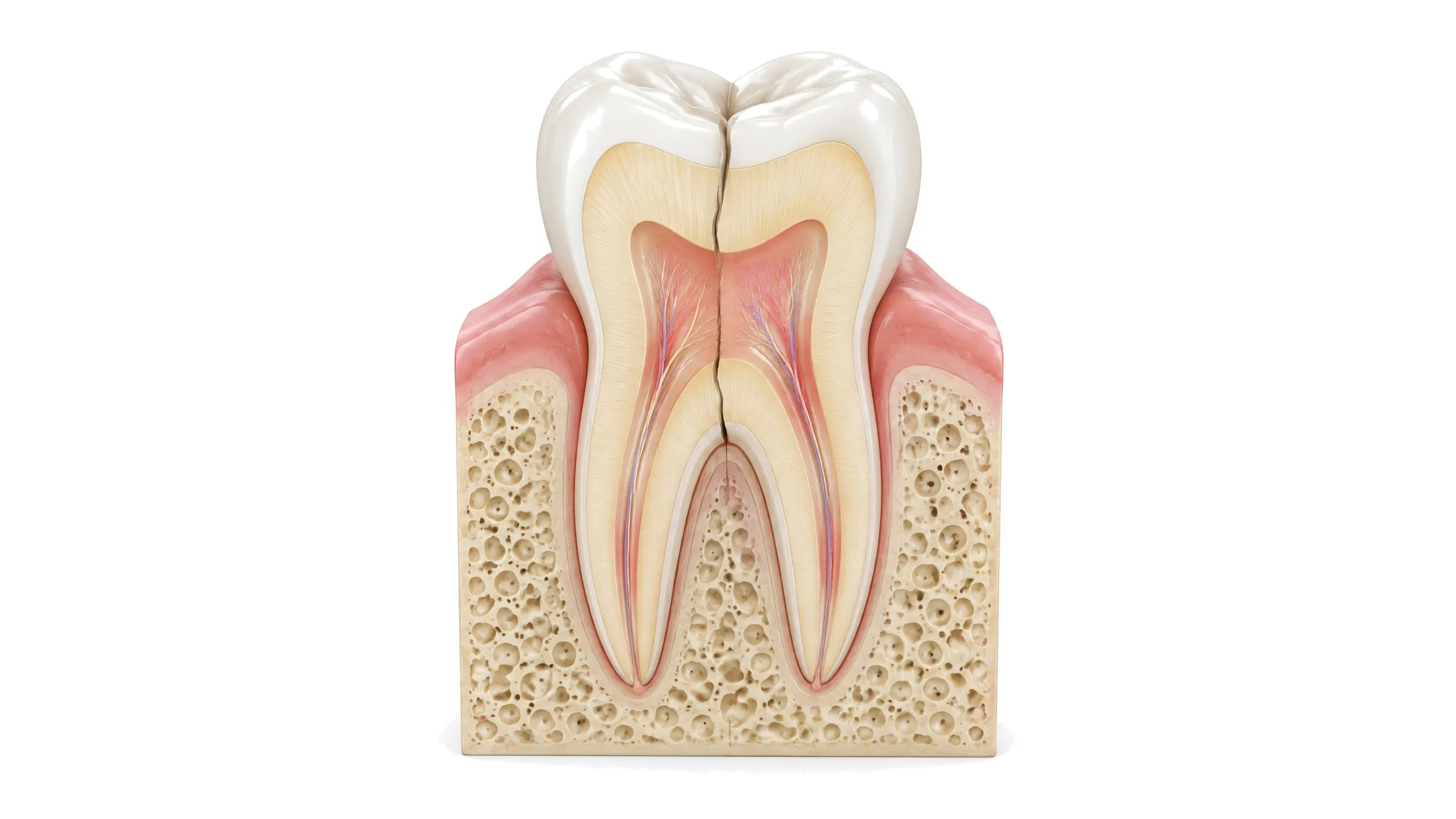
4Cracked tooth
A crack runs from the chewing surface down toward the root. It often hurts when you bite or let go.
Usual repair A crown to hold it together, with a root canal first if the nerve is affected.
-
5Split tooth
The crack runs all the way through and the tooth separates into two parts.
Usual repair Usually removal, then an implant or a bridge. Sometimes part of the tooth can be kept.
How I decide on the repair
When you come in, I am really asking two questions: how much healthy tooth is left, and whether the pulp (the nerve inside the tooth) is still healthy. Your symptoms, a close look, a bite test and an X ray tell me most of that. Then I choose the smallest repair that will actually last.
- Small chips and surface lines are usually smoothed or rebuilt with tooth colored bonding in a single visit, often without numbing.
- A cracked cusp, or a crack that goes deeper than the enamel, usually needs a crown. The crown wraps the tooth and holds it together, so the crack cannot keep opening every time you chew.
- If the crack has reached the nerve, a root canal comes first and the crown follows. We do root canals here in our office, often on the same day you come in.
- When a tooth has split all the way through, it usually cannot be held together. Then we talk about removing it and replacing it, most often with a dental implant, which we place and restore here as well.
| Bonding | Crown | Root canal and crown | |
|---|---|---|---|
| Best for | Small chips and surface lines | Cracked cusps and deeper cracks | Cracks that reach the nerve |
| Visits | Usually one | Usually two | Often two or three |
| Numbing | Often not needed | Yes | Yes |
| What it protects | The edge and the look | The whole tooth | The nerve space and the whole tooth |
Why a small crack should not wait
Your back teeth take a great deal of force every time you chew, and a crack is a weak line that flexes with every bite. Over weeks or months it tends to travel deeper, so a crack that needed bonding can become one that needs a crown, and a crack that needed a crown can reach the nerve and need a root canal first. Once a crack runs far down the root, the tooth often cannot be saved at all.
Bacteria are the other reason. A crack is an opening into the tooth, and an infection that reaches the pulp can turn into an abscess, with pain and swelling that do not settle on their own.
From Dr. Manal Ismail
A small chip is the simplest repair that tooth will ever need. Waiting almost never makes it smaller, so come in while it is still an easy fix.
 Dr. Manal Ismail, DDS
General Dentist
When it is an emergency, and how to be seen today
Call us today if the tooth hurts when you bite, a large piece broke off, the tooth feels loose, or your gum or face is swelling. We see emergency patients the same day, and you do not need to have been here before. We are also open on Saturdays from 9:00 am to 2:00 pm, so a tooth that breaks on a Friday night does not have to wait until Monday.
Go to the emergency room first if you were hit hard in the face, if bleeding will not stop, or if swelling is reaching your eye, your throat or your breathing. Once that is taken care of, call us about the tooth itself.
A small chip that does not hurt is not an emergency. It is still worth a visit within a few days, before the edge chips further or starts to catch your tongue.
Broke or cracked a tooth? Call us today.
Tell us what happened and we will find you the soonest time we have.