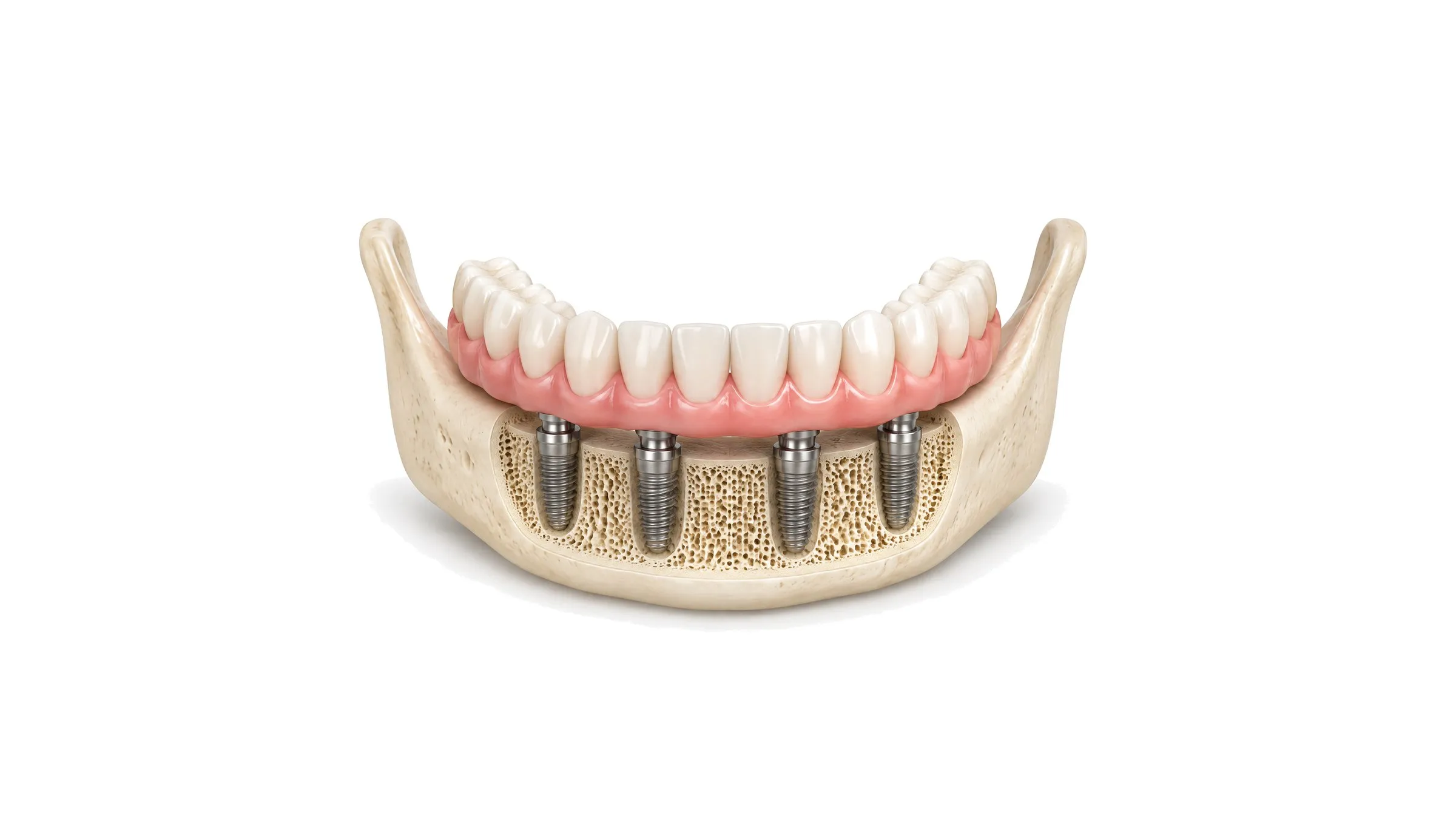
When patients ask me about permanent dentures, what they want is teeth that stay put: no slipping when they laugh, and no skipping the steak at a family dinner. It is a fair thing to want, and there is more than one way to get there. If you are only weighing a regular denture, our dentures page covers how they are made and fitted.
What people mean by permanent dentures
No denture lasts forever. When people say permanent, they mean teeth held in by dental implants instead of resting on the gums. An implant is a small post placed in the jawbone. Once it has healed into the bone, it can carry teeth the way a natural root does.
There are two ways implants can hold a full set of teeth. Either the teeth clip onto the implants and still come out, or they are fixed to the implants and stay in. Both are often called permanent dentures, and they are quite different to live with.
When a patient asks me for permanent dentures, some of them want fixed teeth that never come out. Others would be happy with a denture that clicks in and stays put. Part of the first visit is working out which one they really want.
Three options side by side
A regular denture rests on your gums and is held by suction and the shape of your ridge. A snap in denture looks much the same, but it clicks onto a small number of implants, so it does not lift when you bite into something firm. A fixed full arch is a complete row of teeth fixed to implants, usually four to six in the arch. It does not come out at night, and only your dentist removes it.
With a fixed arch, most patients leave the appointment where the implants are placed with a fixed temporary set the same day. The final teeth are made a few months later, once the implants have healed into the bone. You are not without teeth in between.
We offer all three here: regular full and partial dentures, snap in dentures and fixed full arch teeth on implants. We also make immediate dentures: a removable denture placed the same day any remaining teeth are taken out, so you do not go without teeth while your mouth heals. If you are not sure which one you want, that is normal, and it is what the consultation is for.
Three ways to replace a full arch of teeth
-
1Regular denture
Removable
Rests on your gums and is held by suction and the shape of the ridge, sometimes with adhesive.
No implants. Comes out to clean and at night.
-
2Snap in denture
Clips onto implants
Clicks onto a small number of implants, so it stays put when you eat and talk.
Still comes out every day to clean.
-
3Fixed full arch
Stays in
A full row of teeth fixed to implants, usually four to six in the arch.
Does not come out. Only your dentist removes it.
How each one feels to eat, talk and clean
A regular denture takes the most getting used to. Speech settles within a few weeks for most people, and chewing improves as the denture is adjusted, but the lower one in particular can move, and many people come to rely on adhesive. It covers more of the mouth, and you take it out every night to clean it and rest your gums. Most last somewhere between five and ten years, with a reline or two along the way, because the ridge underneath slowly changes shape.
A snap in denture fixes the biggest complaint, which is movement. It is often the lower denture that gives people the most trouble, because there is less to hold it in place, and that is where a snap in denture makes the biggest difference. It stays where it should while you eat and talk, and you still take it out each day to clean it and the implants it clips onto. The clips wear over time and are replaced as part of normal upkeep.
A fixed full arch feels the most like natural teeth. It does not move and never comes out at home. Cleaning takes a different routine: you brush as usual and clean underneath the bridge where it meets the gum, which we show you on your own set. Checkups matter here, because the gum and bone around the implants are what decide how long the whole thing lasts.
| Regular denture | Snap in denture | Fixed full arch | |
|---|---|---|---|
| Held by | Suction and the shape of your gums | Clips on a small number of implants | Fixed to usually four to six implants |
| Comes out | Yes, every day | Yes, every day to clean | No, only your dentist removes it |
| When you eat | Can move, may need adhesive | Stays in place | Does not move |
| Cleaning | Take out, brush and soak | Take out, clean it and around the implants | Brush, and clean under the bridge where it meets the gum |
| Your jawbone | Slowly shrinks under it | Implants slow the shrinking | Implants help preserve it |
From Dr. Manal Ismail
What patients tell me most is that they stopped thinking about their teeth. They order what they want at a restaurant, and they laugh without covering their mouth.
 Dr. Manal Ismail, DDS
General Dentist
What changes the cost
Each case is planned on its own, so the cost depends on a few things:
- How many implants your jaw needs, from none for a regular denture to several for a fixed arch.
- How much bone you have. Years without teeth, or years of wearing a denture, can thin the jawbone. Where there is not enough, bone grafting rebuilds it first.
- Whether teeth need to come out first. Any extractions are planned into the same treatment.
- The materials chosen for the final teeth.
- The temporary teeth you wear while the implants heal.
Many patients combine what their insurance contributes with monthly payments. We work with Cherry financing and CareCredit, and we go through your benefits with you before you decide anything.
Who is a good fit, and what the first visit covers
A regular denture suits someone who wants the simpler and more affordable route, or whose health makes surgery a poor idea right now, and a well fitted one does its job. A snap in denture is a good middle ground, especially for a lower denture that will not stay put, and it needs fewer implants. A fixed full arch is for someone who wants teeth that feel like their own and never come out, and who has enough bone, or can have bone rebuilt, to support the implants. Smoking, diabetes that is not well controlled and some medications can slow healing, so I look at the whole picture before recommending anything.
At the first visit I look at your remaining teeth, your gums, your bone on imaging and your bite. If you wear a denture now, bring it, because how it fits tells me a lot, along with a list of your medications. Then I lay out which options are realistic for you, the timeline and the cost before anything starts. Implants are placed and restored here in our own office, so the whole plan stays under one roof from the first appointment to the last.
Wondering which option fits you?
A consultation looks at your gums, your bone and your bite, and you leave knowing which options are realistic for you and what each would involve.